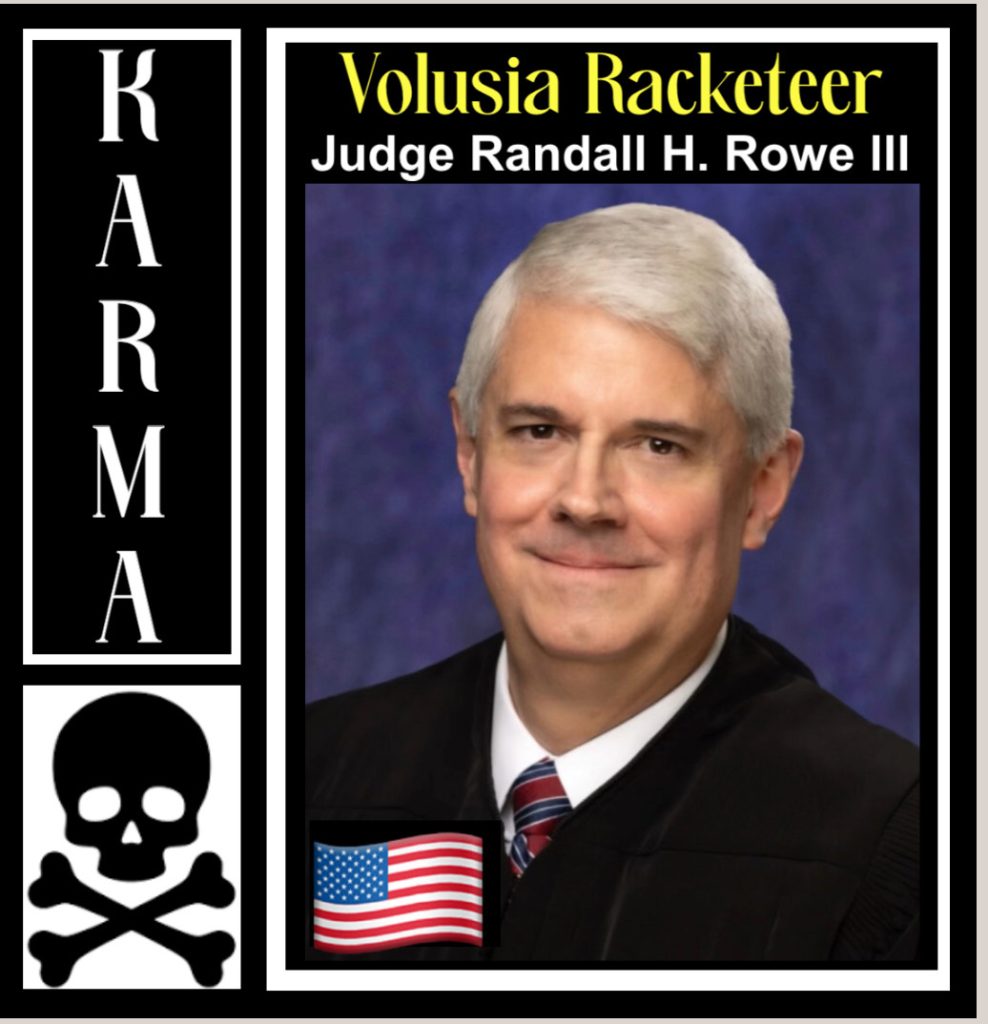
Circuit Judge Randell H. Rowe III: A Disputed Fraud Warrant, Escalating Prosecution, and Unanswered Questions
Why did Izzy Acevedo die with a restraining? No lawful reason!
Circuit Judge Randell H. Rowe III signed an arrest warrant accusing Adam Joshua Macker of participating in an organized scheme to defraud after Macker had already spent more than a year fighting a separate fleeing charge, rejecting plea offers, filing complaints against law enforcement, and repeatedly demanding that the State prove its allegations at trial.
The chronology is central to Macker’s concerns.
The disputed fleeing case began with an October 13, 2021 encounter involving what Macker describes as an unmarked or insufficiently identifiable law-enforcement vehicle. For more than a year afterward, Macker maintained his innocence, challenged the State’s evidence, requested the recordings, filed complaints concerning the involved officers, rejected proposed plea agreements, and insisted upon a public trial.
A trial was reportedly scheduled for November 14, 2022. Macker states that he repeatedly informed his attorneys, prosecutors, law-enforcement officials, and others that he wanted the evidence examined before a jury. That trial did not occur.
On December 7, 2022, after his prior defense firm withdrew, Macker appeared at docket sounding without representation and again refused to accept a plea agreement. According to Macker, the prosecutor questioned his competency after reviewing complaints in which Macker challenged the State’s evidence and reported broader law-enforcement and financial misconduct.
Approximately three weeks later, on or about December 27–28, 2022, Judge Rowe signed an entirely separate warrant accusing Macker of an organized scheme to defraud through Community Outreach—a business that had already been closed for nearly three years.
Macker alleges that the chronology reflects escalating government pressure. After spending more than a year fighting what he maintains was an unsupported fleeing charge, rejecting plea offers, demanding trial, filing official complaints, and investigating suspected financial misconduct, he was confronted with an additional organized-fraud warrant involving a long-closed business.
Macker believes officials were effectively “hitting him with whatever they could” because he refused to accept the original accusations, abandon his demand for trial, or stop investigating the broader misconduct he believed he had uncovered.
This allegation reflects Macker’s interpretation of the documented sequence. No court or disciplinary authority has issued a final finding that Judge Rowe or other officials coordinated a retaliatory campaign. Nevertheless, the timing raises serious questions about whether government authority was repeatedly used to increase pressure on a defendant who refused to surrender his right to trial.
More Than a Year Fighting the Fleeing Charge
The original criminal case arose from an October 13, 2021 encounter involving Volusia County Deputy Meshelle Naylor.
Macker states that he was driving home from his daughter’s school when an unmarked or insufficiently identifiable vehicle briefly activated emergency lights and sirens behind him. He maintains that he did not knowingly flee law enforcement.
Because his child was in the vehicle and he was uncertain whether the vehicle behind him was operated by a legitimate officer, Macker states that he continued approximately one mile to his nearby residence while obeying the speed limit.
He was nevertheless arrested and charged with fleeing and child neglect.
Macker alleges that the official charging narrative failed to accurately describe the identification of the vehicle, the brief activation of its emergency equipment, the presence of his child, and his decision to drive directly to his nearby home.
Over the following year, Macker repeatedly demanded the evidence supporting the charges. According to his complaints and court filings, the State represented that video evidence showed him fleeing. However, the recordings eventually produced allegedly did not depict the charged act of fleeing.
Macker states that no dash-camera recording showing him knowingly fleeing from a clearly identified law-enforcement vehicle was produced. He maintains that the available body-camera footage began after the disputed driving had already occurred and therefore could not independently prove the central allegation.
Despite these evidentiary disputes, the case remained pending for more than a year.
Macker repeatedly rejected plea agreements and insisted upon trial. He maintains that he wanted the State to identify the alleged video evidence, present its witnesses, and prove the charge before a jury.
Instead, the scheduled trial did not occur, his defense firm withdrew, his competency was questioned, and a separate organized-fraud warrant was issued only weeks later.
Internal Affairs Complaints and the Continued Demand for Trial
In November 2022, Macker submitted complaints concerning the officers involved in the fleeing case and the manner in which the case was being handled.
Those complaints challenged the accuracy of the law-enforcement narratives, the absence of video depicting the alleged offense, the treatment of Macker and his child, and what Macker believed was a broader pattern of harassment and retaliation.
Macker states that instead of receiving the requested investigation or trial, the proceedings continued to be delayed.
By late November 2022, his relationship with his defense firm had deteriorated. The firm withdrew before the December 7, 2022 docket sounding, requiring Macker to appear without representation.
At that proceeding, Macker again refused to accept a plea agreement.
According to Macker, the prosecutor briefly reviewed his Internal Affairs complaints, referred to them as “letters,” questioned his competency, and recommended a psychological evaluation.
Macker contends that his refusal to plead guilty and his insistence upon discussing the evidence were treated as signs of mental instability rather than the lawful actions of a defendant exercising his constitutional right to trial.
Discovery of Suspected Court-Record Irregularities
After the December 7 proceeding, Macker states that he became convinced the problems extended beyond the conduct of individual officers.
On or about December 15, 2022, he began independently examining records available through the Volusia Clerk of Court’s public system. He alleges that he discovered cases containing payment receipt numbers followed years later by additional satisfactions, collection entries, judgments, or financial obligations.
Macker interpreted those records as evidence that previously satisfied court debts were being revived, duplicated, or collected again.
He further alleges that disputed court obligations were being used to suspend driver’s licenses and pressure citizens into submitting additional payments through collection processes involving the Clerk’s Office and its private collection contractor.
On or about December 22, 2022, Macker states that he discussed these discoveries with his father.
Approximately five or six days later, Judge Rowe signed the organized-fraud arrest warrant concerning Community Outreach.
Macker believes that proximity is significant. He alleges that after refusing to plead guilty, demanding trial, filing Internal Affairs complaints, and beginning to expose suspected court-related financial irregularities, he was confronted with an additional serious felony accusation involving a business that had been closed since March 2020.
Timing alone does not establish retaliation, coordination, or judicial misconduct. There has been no final finding that Judge Rowe knew about Macker’s investigation of the Clerk’s records when he reviewed the warrant application.
The sequence nevertheless raises an important question:
Why was an organized-fraud warrant involving a long-closed business issued only after Macker had spent more than a year fighting an unrelated fleeing charge, rejected plea offers, demanded trial, filed complaints against law enforcement, and begun investigating suspected financial irregularities within the court system?
The Community Outreach Business
The organized-fraud allegations concerned a business known as Community Outreach.
Macker describes Community Outreach as a print, advertising, and community-safety company that partnered with schools, fire departments, nonprofit organizations, local businesses, and other community groups throughout the United States.
The company produced dual-sided, dry-erase, magnetized safety boards containing emergency contact information, fire-prevention guidance, child-safety information, anti-bullying messages, addiction-recovery resources, and space for important family messages.
Local businesses purchased advertising and sponsorship placements on the boards. Participating schools, fire departments, nonprofit organizations, and community partners then distributed the materials to families throughout their communities.
Macker emphasizes that Community Outreach primarily sold advertising services to businesses. He disputes any suggestion that its principal activity involved soliciting charitable donations from individual consumers.
The company’s stated mission focused on public safety, youth education, fire prevention, anti-bullying awareness, addiction recovery, and the distribution of useful emergency information.
Only Three Complaints Among More Than 3,500 Clients
According to Macker and the business records he cites, Community Outreach operated for approximately five years and served more than 3,500 clients, yet the organized-fraud allegations involved only three formal complaints.
Macker contends that this was essential context that should have been carefully examined before an organized-fraud warrant was approved.
Three complaints among more than 3,500 clients would represent fewer than one-tenth of one percent of the company’s reported client base. Macker argues that such a limited complaint history is materially inconsistent with the portrayal of Community Outreach as a business created or operated as a deliberate criminal scheme.
The existence of three complaints does not mean those complaints should have been ignored. Any customer who believed that he or she had been deceived was entitled to have the allegation evaluated.
However, Macker argues that investigators and the judge reviewing the warrant application should have carefully distinguished between:
- Intentional criminal deception.
- An ordinary customer-service complaint.
- A disagreement over contractual performance.
- Delayed production or distribution.
- A disputed renewal.
- A requested refund or chargeback.
- A project interrupted by the closure of the business.
- A transaction involving a separate corporate entity.
- Partial performance or completed advertising services.
- Evidence of fraudulent intent at the time of the transaction.
Macker alleges that the warrant presentation failed to give Judge Rowe a complete and balanced picture of Community Outreach’s five-year operating history, thousands of clients, nationwide partnerships, completed projects, advertising model, and public-safety mission.
The central issue was not simply whether three customers complained. The issue was whether those isolated complaints established probable cause to believe that Macker intentionally created or operated Community Outreach as an organized criminal scheme.
A Business Closed Nearly Three Years Earlier
Community Outreach ceased operating in or around March 2020, when the COVID-19 pandemic disrupted the company’s operations.
The arrest warrant was not issued until December 2022—approximately two years and nine months after the business closed.
The closure of a business does not prevent law enforcement from investigating alleged earlier conduct. The passage of time does, however, make it especially important to distinguish intentional criminal conduct from business failure, disrupted projects, contractual disagreements, delayed performance, and unresolved customer-service matters.
Macker alleges that the warrant application failed to adequately present or examine important context, including:
- The company’s approximately five-year operating history.
- Its service to more than 3,500 clients.
- The existence of only three formal complaints.
- The percentage of the total client base represented by those complaints.
- Its partnerships with schools, fire departments, nonprofit organizations, and local businesses.
- Its advertising and sponsorship model.
- The public-safety purpose of the products it distributed.
- The different corporate entities involved in its operations.
- The company’s closure nearly three years before the warrant was issued.
- The effects of the COVID-19 pandemic on its operations.
- Whether the complaining parties received advertising, artwork, partial performance, refunds, credits, or other services.
- Whether the evidence demonstrated fraudulent intent at the time each transaction occurred.
Macker contends that without this information, the warrant presentation could have created the misleading impression that complaints were widespread or representative of Community Outreach’s overall operations.
Judge Rowe’s Probable-Cause Determination
A judge reviewing an arrest-warrant application performs one of the judiciary’s most important constitutional functions.
The judge must independently determine whether the sworn information presented establishes probable cause. A judge is not expected to simply approve the conclusions requested by an investigator.
Judge Rowe’s signature transformed the investigator’s allegations into legal authority to locate, arrest, handcuff, transport, and incarcerate Macker.
In Macker’s later federal civil-rights litigation, defense counsel relied heavily upon Judge Rowe’s approval of the warrant, arguing that law-enforcement officers were entitled to rely on the judicial finding of probable cause when they arrested Macker.
That demonstrates why careful and independent judicial review at the warrant stage is so important.
Macker does not merely argue that Judge Rowe reached a decision with which he disagrees. He questions whether the judge received—or required—a complete and accurate presentation of the facts before authorizing his arrest.
Among the unresolved questions are whether Judge Rowe was informed that:
- Community Outreach had served more than 3,500 clients.
- Only three formal complaints allegedly existed.
- The company had operated for approximately five years.
- The company primarily sold advertising to businesses.
- Its products promoted child safety, fire prevention, anti-bullying awareness, and addiction recovery.
- The company had closed nearly three years earlier.
- Different corporate entities were involved in its operations and revenue.
- The complaints represented only a minute fraction of the company’s total business.
- Evidence existed of completed work, partial performance, credits, refunds, or chargebacks.
- Macker had already been fighting a separate criminal prosecution for more than a year.
- Macker had rejected plea offers and repeatedly demanded a trial.
- Macker had recently begun reporting suspected misconduct involving court and collection records.
Not every fact concerning Macker’s separate criminal case would necessarily have been relevant to probable cause for the Community Outreach warrant. The critical question is whether the warrant application fully and accurately presented the facts directly bearing upon the legitimacy of the business and the existence of criminal intent.
Allegations of Escalating Government Pressure
Macker believes that the organized-fraud warrant was part of an escalating pattern in which new forms of government pressure appeared whenever an earlier effort failed to produce his cooperation or silence.
He describes the sequence as follows:
First, his driver’s license was suspended over an old court obligation he maintains had already been paid.
He was then confronted at gunpoint and charged with fleeing after driving approximately one mile home with his child.
He spent more than a year demanding the evidence, rejecting plea offers, filing complaints, and insisting upon trial.
When he continued demanding trial, his competency was questioned.
When he began independently investigating court records and reporting suspected financial misconduct, a new organized-fraud warrant was issued concerning a business that had been closed for nearly three years.
Macker alleges that this chronology reflects escalating government pressure. After spending more than a year fighting what he maintains was an unsupported fleeing charge, rejecting plea offers, demanding trial, filing official complaints, and investigating suspected financial misconduct, he was confronted with an additional organized-fraud warrant involving a long-closed business.
Macker believes officials were effectively “hitting him with whatever they could” because he refused to accept the original accusations, abandon his demand for trial, or stop investigating the broader misconduct he believed he had uncovered.
This conclusion is based on Macker’s interpretation of the sequence. It has not been established as a final finding that Judge Rowe, prosecutors, law-enforcement officers, or other officials coordinated a retaliatory campaign.
Arrest Outside the FBI Office
On January 4, 2023, approximately one week after the warrant was issued, Macker traveled to the FBI office on South Keller Road in Maitland.
Macker states that he went there to report suspected financial irregularities he had identified in Volusia County court and collection records. He maintains that he did not know Judge Rowe’s warrant existed and did not travel to the FBI office to surrender.
He was arrested outside the FBI office and transported to the Orange County Jail.
Macker alleges that Maitland Detective Brian Quinn incorrectly told the arresting officer that Macker had gone to the FBI office to turn himself in.
Macker disputes that characterization. He states that he was attempting to report suspected public corruption and was arrested before he could meaningfully present the information he had gathered.
This distinction is important because the official characterization suggests that Macker knowingly appeared at the FBI office because he was aware of the warrant. His account is that he independently sought federal assistance concerning suspected financial crimes and was arrested on a warrant he did not know existed.
Regardless of the officers’ understanding of his purpose, Judge Rowe’s signature supplied the legal authority for the arrest.
Alleged Surveillance, Harassment, and “Gang Stalking”
Macker states that these events occurred during an extended period in which he believed he was being followed, monitored, intimidated, and deliberately provoked.
In his complaints and court filings, he referred to this pattern as “gang stalking.”
That phrase is included as Macker’s contemporaneous description of what he believed he was experiencing. It is not presented as a final judicial finding that an organized stalking operation existed.
Macker states that he repeatedly contacted law enforcement, the FBI, Internal Affairs, elected officials, and other agencies regarding alleged surveillance, identity theft, financial fraud, threats, and suspicious encounters.
He contends that his reports were repeatedly dismissed while criminal accusations and legal restrictions against him continued to escalate.
There is presently no established evidence that Judge Rowe directed, participated in, or knew about the alleged surveillance or harassment. Its relevance to this page is contextual: Macker alleges that the organized-fraud warrant intensified an existing pattern in which his requests for protection or investigation were disregarded while increasingly serious government action was taken against him.
Ishmael “Izzy” Acevedo and the Motorcycle Matter
A second area of concern involves Macker’s friend Ishmael “Izzy” Acevedo and a motorcycle Macker had reported stolen after it was not returned.
On or about March 16, 2023, Macker states that he delivered a letter to Judge Rowe explaining that he did not wish to pursue charges against Acevedo.
Macker states that his intention was to recover the motorcycle, resolve the dispute, and prevent his friend from remaining incarcerated over property that Macker no longer wished to treat as stolen.
Macker alleges that Judge Rowe released Acevedo only after Acevedo was required to accept a restraining or no-contact condition preventing communication with Macker.
The exact order and hearing record should be examined to determine whether the restriction was a civil injunction, criminal no-contact order, or condition of bond or release.
Macker alleges that Judge Rowe imposed or approved a no-contact restriction between Macker and Acevedo despite Macker’s written statement that he did not wish to pursue the motorcycle complaint.
On or about March 19, 2023, Acevedo retrieved the motorcycle and attempted to return it to Macker’s residence. According to Macker, Acevedo also contacted authorities in an effort to have the stolen-vehicle alert withdrawn.
Deputies arrived at Macker’s property, allegedly refused to withdraw the alert, impounded the motorcycle, and arrested Acevedo for dealing in stolen property.
Macker questions why a no-contact condition was considered necessary when he had affirmatively told the court that he did not wish to pursue charges and wanted the property returned.
Acevedo’s Later Death
Ishmael Acevedo later died.
There is no identified evidence establishing that Judge Rowe caused, contributed to, or had any involvement in Acevedo’s death. This page does not allege such a causal connection.
Macker’s concerns are narrower:
- Why was a no-contact condition imposed?
- Who requested it?
- What evidence supported it?
- Was Macker’s letter considered?
- Was either person alleged to pose a danger to the other?
- How long did the restriction remain active?
- Did it prevent or discourage Macker from communicating with his friend before Acevedo died?
Macker’s concern is both personal and procedural. His friend died while a judicially imposed restriction allegedly prevented or discouraged communication between them, and Macker states that he still does not understand the factual or legal basis for the restriction.
Judicial Responsibility and Public Confidence
An unfavorable judicial ruling does not automatically constitute judicial misconduct.
Judges regularly make difficult decisions based on disputed or incomplete information. Errors ordinarily must be addressed through motions, appeals, and other authorized legal procedures.
The concerns presented here are more specific.
Macker alleges that Judge Rowe authorized an arrest for organized fraud without adequately accounting for the company’s operating history, extremely limited number of complaints, total client base, closure, advertising model, corporate structure, and evidence relevant to criminal intent.
Macker also alleges that Judge Rowe imposed or approved a no-contact restriction involving Acevedo without a sufficiently disclosed reason, even after Macker informed the court that he did not wish to pursue the motorcycle complaint.
Macker questions whether Judge Rowe:
- Meaningfully scrutinized whether three customer complaints established an organized criminal scheme.
- Required investigators to place those complaints in the context of more than 3,500 clients.
- Distinguished ordinary contractual disputes from intentional fraud.
- Reviewed the relevant corporate structure and sources of revenue.
- Considered that the business had closed nearly three years earlier.
- Examined evidence showing completed work, partial performance, refunds, credits, or chargebacks.
- Considered the timing of the warrant after Macker’s year-long refusal to accept a plea in a separate case.
- Required a stated factual basis for restricting communication between Macker and Acevedo.
- Considered Macker’s written statement that he did not wish to pursue the motorcycle complaint.
These allegations have not been established as findings of judicial misconduct. They are questions that should be evaluated through the warrant affidavit, supporting exhibits, investigative reports, customer records, business records, hearing audio, court orders, and correspondence delivered to the court.
Judicial Qualifications Commission Concerns
Macker has identified these events as grounds for review by the Florida Judicial Qualifications Commission.
The JQC investigates allegations of misconduct involving Florida judges. It does not operate as an appellate court and cannot reverse a warrant, vacate a criminal charge, modify a release condition, or correct an alleged legal error merely because a complainant disagrees with a ruling.
Macker’s concerns include:
- Whether the organized-fraud warrant received meaningful and independent judicial review.
- Whether material context favorable to Macker was omitted or disregarded.
- Whether the timing created an appearance of escalating retaliation.
- Whether three complaints among more than 3,500 clients reasonably established an organized criminal scheme.
- Whether the no-contact restriction involving Acevedo had a documented legal and factual basis.
- Whether Macker’s written request concerning the motorcycle was meaningfully considered.
- Whether law-enforcement allegations were accepted without sufficient scrutiny.
Submitting a complaint does not establish that the JQC agreed with the allegations or found probable cause. The allegations remain subject to investigation and independent review.
Connection to the Federal Civil-Rights Litigation
These events became part of the factual chronology in Macker’s federal civil-rights action:
Macker v. Macker et al.
United States District Court, Middle District of Florida
Case No. 6:23-cv-01963-JSS-DCI
The district case later became associated with Macker’s appeal before the United States Court of Appeals for the Eleventh Circuit:
Appeal No. 25-12280
Judge Rowe was not named as a defendant in the operative federal complaint. His involvement remains relevant because the warrant bearing his judicial approval supplied the legal authority for Macker’s January 4, 2023 arrest outside the FBI office.
Macker views these events as part of a broader sequence involving:
- The disputed suspension of his driver’s license.
- The October 2021 fleeing charge.
- The alleged absence of video evidence showing the offense.
- Repeated Internal Affairs complaints.
- More than a year of rejected plea offers and demands for trial.
- Competency proceedings after he continued asserting his innocence.
- The discovery of suspected court-record irregularities.
- The organized-fraud warrant concerning Community Outreach.
- His arrest outside the FBI office.
- The motorcycle matter involving Acevedo.
- Later law-enforcement action at Macker’s residence.
- Detention without bond and the resulting felony disposition.
The proximity of separate events does not independently prove a coordinated conspiracy. Macker’s position is that the complete chronology deserves investigation as a whole rather than dismissal through isolated examination of each incident.
Questions the Public Deserves Answered
The public deserves to know:
- Was Judge Rowe informed that Community Outreach served more than 3,500 clients over approximately five years but generated only three formal complaints?
- What evidence transformed those isolated complaints into probable cause for an organized scheme to defraud?
- Did the warrant application accurately describe the company’s advertising model and public-safety mission?
- Were completed projects, refunds, credits, chargebacks, or partial performance disclosed?
- Did the application accurately identify the relevant corporations and sources of revenue?
- Was Judge Rowe informed that Community Outreach had closed in March 2020?
- What evidence established criminal intent rather than ordinary business or contractual disputes?
- Was the judge aware that Macker had spent more than a year fighting a separate fleeing charge and repeatedly insisting upon trial?
- Why was the separate fraud warrant issued only weeks after Macker rejected another plea and began investigating suspected court-record irregularities?
- Why was Macker arrested outside the FBI office while, according to his account, attempting to report suspected public corruption?
- What type of order restricted communication between Macker and Acevedo?
- Who requested the restriction, and what evidence supported it?
- Did Judge Rowe receive and consider Macker’s March 16, 2023 letter?
- Why was a no-contact restriction imposed when Macker stated that he did not wish to pursue the motorcycle complaint?
These questions can be answered through records.
The public should be able to examine the complete warrant affidavit, supporting evidence, investigative reports, customer records, business documentation, hearing recordings, release conditions, docket entries, and correspondence before reaching an informed conclusion.
Why This Page Matters
A judge’s signature carries enormous power.
It can authorize law-enforcement officers to seize a citizen, place him in handcuffs, remove him from his family, transport him to jail, damage his reputation, and require him to defend himself against serious felony allegations.
Because that power is so consequential, the public must be able to trust that it is exercised independently, carefully, and only after meaningful examination of a complete and accurate record.
Adam Joshua Macker alleges that Judge Randell H. Rowe III authorized an organized-fraud warrant after Macker had spent more than a year fighting an unrelated fleeing charge, rejecting plea agreements, filing complaints, and demanding trial.
The warrant concerned a company that had operated for approximately five years, served more than 3,500 clients, generated only three formal complaints, promoted public-safety programs, sold advertising primarily to businesses, and had already been closed for nearly three years.
Macker contends that the timing and surrounding circumstances create the appearance that when the original prosecution failed to produce a plea, new and increasingly serious government pressure was applied.
That conclusion has not been established by a court or disciplinary tribunal. It is Macker’s interpretation of a documented chronology that he believes warrants independent examination.
The public should not be asked to accept his conclusions without reviewing the evidence. Nor should these questions be dismissed without examining the records on which they are based.
The records should speak for themselves.
Important Notice
The statements on this page describe allegations contained in court filings, complaints, correspondence, business records, public records, and the personal account of Adam Joshua Macker.
Nothing on this page should be interpreted as a final finding that Judge Randell H. Rowe III committed judicial misconduct, participated in a conspiracy, knowingly approved false information, retaliated against Macker, caused or contributed to the death of Ishmael Acevedo, or incurred criminal or civil liability.
The sequence of events is presented to explain why Macker believes the organized-fraud warrant and related judicial actions require independent review. Temporal proximity alone does not prove coordination, retaliation, conspiracy, or improper motive.
A judicial decision is not misconduct merely because a party believes it was legally or factually incorrect. All individuals are entitled to fairness and an opportunity to respond.
Readers are encouraged to examine the warrant application, affidavit, supporting exhibits, hearing records, business documentation, court orders, federal filings, and other linked source materials before reaching any conclusion.


144 Thousand Ave. Daytona Beach, FL 32114
Adam@VolusiaTruth.com
corruptionstopper2023@gmail.com